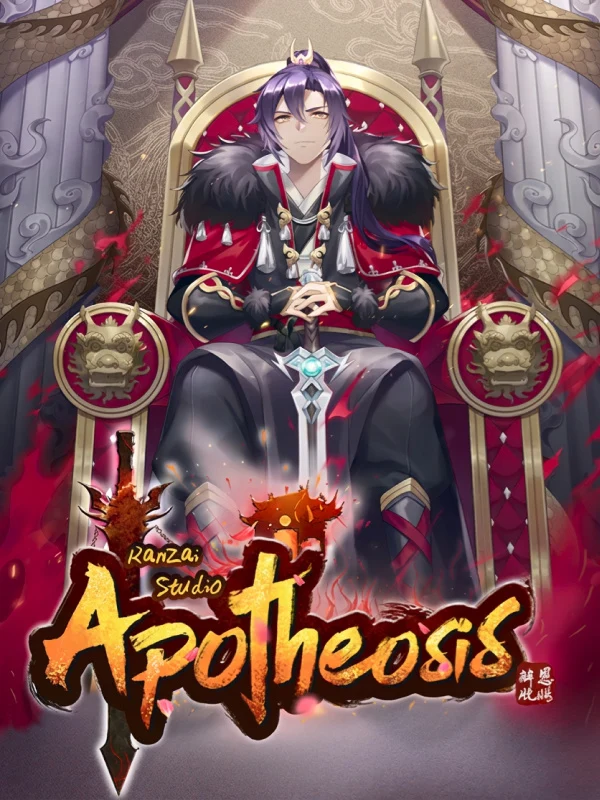
Apotheosis is a good comic to sample if you want a forceful cultivation comeback with a personal reason behind it. Luo Zheng’s opening conflict combines family betrayal, humiliation and concern for his sister. The body-refinement premise makes his first change in fortune easy to grasp. The tradeoff is blunt cruelty and a convenient supernatural breakthrough rather than a gradual, restrained character drama.
This review is about the manhua, not the 3D donghua. It discusses the opening family conflict and power discovery with early premise spoilers, while leaving later outcomes out of the recommendation.
Luo Zheng’s situation gives the action a reason
The comic introduces Luo Zheng reading by candlelight in his family’s dungeon. His response to a moral teaching is immediately revealing: he cannot accept answering harm with kindness after what has happened to his branch of the family. That is a more specific starting point than simply saying he wants to become powerful.
The household conflict makes power tangible. Luo Peiran has access to a valuable elixir and uses his advantage to intimidate others. A steward can withhold healing pills from Luo Zheng because his former position no longer protects him. Cultivation resources are part of a hierarchy that decides who can recover, train and exercise authority.
His sister Luo Yan gives the ambition a purpose beyond restoring pride. News that she is in trouble changes his urgency. You do not need to memorize the family tree to follow the emotional stakes: he cannot protect someone close to him while remaining powerless.
What makes the body-refinement premise interesting?
A mysterious technique changes how Luo Zheng’s body responds to punishment. The early sequence treats the body like something that can be forged. Heat, a cauldron and a painful transformation give the idea a physical form rather than leaving it as a new rank announced in dialogue.
The useful payoff comes when familiar abuse stops having the expected effect. The people hitting him think the relationship is unchanged. Luo Zheng realizes the experience can contribute to his development. The same action now has a different meaning for the two sides.
The power fits the conflict: punishment is the family’s way of controlling him, and refinement begins to turn that punishment into an advantage. This makes his confidence understandable even before you learn the later cultivation ranks.
It is also a large gift from the plot. The extraordinary discovery arrives early and rapidly changes his prospects. Readers who want advancement to emerge mostly from long training, ordinary resources or repeated technical failure may find the breakthrough too generous.
Is Luo Zheng an interesting lead?
He is decisive and angry, with a clear attachment to his sister. The early writing makes those qualities easy to understand. He is not presented as a gentle observer who happens to stumble into fighting; his response to mistreatment shapes the direction of the story.
A small moment in the dungeon keeps him from being entirely one-note. After directing his frustration at the book he has been reading, he recognizes that the book itself is not responsible for his inability to change things. His impatience turns back toward his own situation. That pause gives his anger a little more shape before the supernatural discovery.
The surrounding antagonists are less subtle. Several express their superiority through threats, humiliation and misuse of status. That is effective fuel for a revenge fantasy, but it leaves little ambiguity about whom to oppose. If you prefer rivals with complicated competing interests, the opening may feel too heavily weighted toward a single side.
Action and artwork: strong visual cues, frequent explanation
The opening uses color to separate types of experience. The dungeon has dim stone and candlelight. Cultivation events introduce bright gold, blue and purple effects. The shift helps you recognize when an ordinary confrontation has become something supernatural.
Close-ups emphasize defiance and surprise, while wider panels show where a blow sends someone. The action is readable at the level that matters for the early story: who expects control, what they attempt and why the result changes that expectation.
Thought bubbles and explanatory dialogue are frequent. They help a newcomer understand the refinement premise, but they can slow an exchange that the images have already made clear. If you enjoy the mechanics of power, those explanations may be part of the attraction. If you prefer uninterrupted visual action, expect pauses.
Does the opening move quickly enough?
The first chapter covers substantial ground: confinement, a public threat, the sister’s predicament, a discovery and a changed response to violence. You do not have to wait through a long peaceful introduction to learn the central conflict.
That speed has a cost. The household contains several people whose role is to demonstrate how badly Luo Zheng is treated. Repeated contempt makes the eventual reversal easy to anticipate. The dramatic question becomes how he will respond, rather than whether the situation has another interpretation.
The sister’s predicament gives the fast power-up a reason to matter beyond settling a score. That is the question the opening leaves you with: can Luo Zheng use his new ability to help her, rather than simply survive another beating? The urgent family goal is a stronger hook than the prospect of another contemptuous rival.
Should you read the manhua or watch the donghua?
Choose the comic if you like pausing over diagrams, thought bubbles and the steps of a power discovery. Luo Zheng’s changing response to violence is explained in detail, so it suits readers who want to understand the ability as well as see it used.
Choose the donghua if animated fights, voices and music are the draw. Our Apotheosis donghua review covers that version separately. The art and pacing discussed here belong to the comic.
Start the comic at Season 1 Chapter 1 rather than choosing a chapter with the same number as your last episode. Episode and chapter numbers do not establish equivalent stopping points. Beginning with Luo Zheng’s family conflict also makes it easier to recognize changes between versions without relying on an uncertain conversion chart.
Is the English Apotheosis manhua complete?
Webnovel’s English comic listing showed 225 entries at the time of checking, using season labels within its chapter titles. That describes this platform edition. It should not be read as the total length of the original Chinese manhua or as proof that the whole story is complete.
This catalog is not evidence of a complete English edition. If a finished binge is your priority, check that the service offers the actual concluding chapter before buying. Its season labels organize comic chapters; they are not a guide to the donghua’s seasons.
Where to read Apotheosis in English
Read the Apotheosis comic on Webnovel. Its opening entry is “Season 1 Chapter 1 Refinement Technique.” Check the current chapter unlock conditions as you read; an available sample does not mean the entire catalog is free.
The INKR listing currently states that the title has been removed from sale, so it is not a new-purchase route to recommend. Existing customers should follow that platform’s account-access guidance.
Expect bloody violence, enslavement, abusive treatment and family threats from the beginning.