Death Note is still worth watching if you enjoy strategic rivalries, morally uncomfortable protagonists and suspense built from small decisions. Its greatest strength is turning information into danger: knowing something, revealing something or making the wrong assumption can change who has the advantage. Its weaknesses are an overreliance on explanation and a later stretch that does not always match the grip of the opening rivalry.
This review covers the 37-episode anime that began in 2006, not the live-action films or television adaptations. It discusses the premise and style without revealing major reversals or the ending. If you mainly want fights or a hero you can comfortably cheer for, this is a less obvious recommendation.
Death Note at a glance
Scroll across to compare all columns →
| Format | 2006 TV anime; 37 episodes; complete main story |
|---|---|
| Studio and director | MADHOUSE; Tetsuro Araki |
| Viewing time | About 14 hours at roughly 23 minutes per episode |
| Best for | Mind games, cat-and-mouse tension and moral conflict |
| Main reservations | Heavy internal monologue, uneven later pacing and limited space for some supporting characters |
| Content to expect | Murder, suicide, coercion and sustained psychological pressure |
| Official viewing | Hulu / Netflix, subject to region |
Nippon TV’s program catalog confirms the production details and episode count. The viewing-time estimate includes credits, not ads or breaks.
Watch our spoiler-free Death Note review
Prefer to watch? Our nine-minute review covers the mind games, characters, pacing and who the anime is best suited to, without revealing major twists or the ending.
What is Death Note about?
Light Yagami is a brilliant student who finds a notebook with a lethal rule: a person whose name is written in it will die, provided its user can identify their face. Light decides to use that power against criminals and imagines himself creating a better world. The deaths attract the attention of L, an elusive detective determined to find the person responsible.
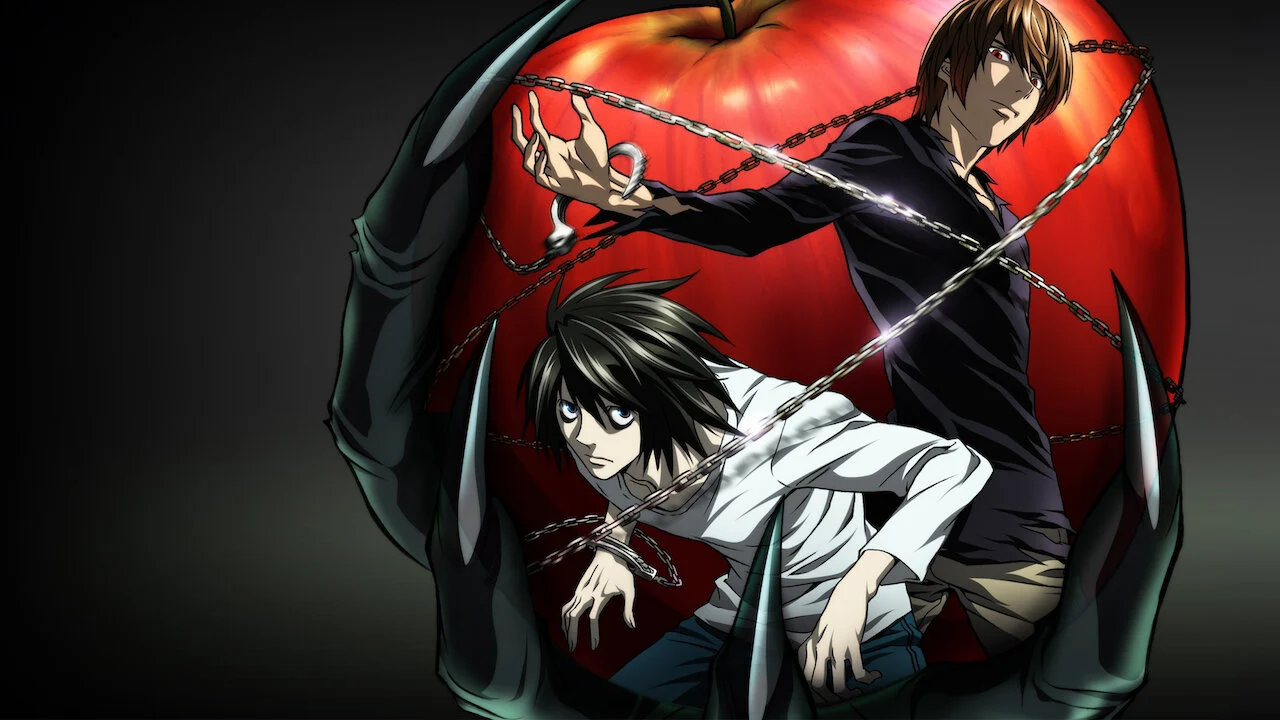
That setup gives the story a useful imbalance. Light has supernatural power, but he still lives in an ordinary world where schedules, relationships and evidence can expose him. L lacks the same weapon, but can shape situations that force his opponent to reveal information. Neither side needs to overpower the other physically for a scene to become dangerous.
Ryuk, the shinigami connected to the notebook, adds an unsettling distance to the human conflict. His presence makes it difficult to treat Light’s sense of destiny as the story’s own endorsement. The notebook gives Light an opportunity; what he makes of it remains his choice.
Why the mind games work
The strongest part of Death Note is the gap between what a character knows and what that character can prove. Suspicion alone is not enough for L. Having a weapon is not enough for Light. Both have to anticipate how an action will look to someone who possesses only part of the picture.
The early televised confrontation is a concise demonstration of that principle. Without giving away its mechanism, it turns communication into an experiment: the important question is not just what is said, but what a reaction might reveal. An audience member can understand the stakes before understanding every part of the trap.
That pattern keeps everyday activities interesting. A conversation can be a test. Appearing calm can be a performance. Cooperation can be sincere, calculated or both at once. The show repeatedly asks you to consider how the same behavior might support two different interpretations.
There is a limitation, though. This is not always a fair-play puzzle in which the viewer has every fact needed to solve a problem first. Rules, planning and explanations sometimes arrive as part of a reveal. It works better as a suspenseful contest between characters than as a promise that you can outguess every move from the sofa.
Light and L: compelling without being comfortable
Light’s confidence makes him an effective lead because it creates its own vulnerability. He wants to control the practical situation, but also wants his judgment to be recognized. The tension between those desires makes his decisions more revealing than a simple portrait of an infallible genius would be.
L is an engaging counterweight because he makes certainty feel provisional. His unusual manner can be funny, yet his role in the story is serious: he constantly tests the distance between a strong hunch and a defensible conclusion. Their scenes invite you to read what is happening underneath the spoken exchange.
Following Light does not require approving of him. In fact, much of the interest comes from seeing how easily the language of justice can slide toward entitlement. The story lets the attraction of decisive power sit beside the ugly question of who gave one person the right to exercise it.
The supporting cast is less evenly served. Some characters become valuable mainly because of the pressure they place on the central contest. Misa, in particular, has a striking presence but is too often constrained by her relationship to Light. If you prefer an ensemble where everyone receives comparable independence and development, this is a real reservation.
How direction and sound turn thought into action
A series about people thinking could easily become visually inert. Death Note avoids that through expressive framing, severe contrasts in light and shadow, abrupt emphasis and an almost operatic approach to ordinary actions. Writing a name is rarely presented as a neutral piece of administration.
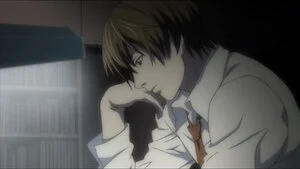
That heightened style gives internal decisions physical energy. Close-ups make a look or a pause feel significant; changes in rhythm tell you when apparent composure is under strain. The music’s ominous and theatrical qualities reinforce the feeling that the characters see themselves as participants in something much larger than a police case.
Whether that works for you is partly a question of taste. The presentation is persuasive when you accept the melodrama. If you want a restrained crime procedural, the emphatic visual language and frequent inner narration can feel as though the show is underlining something you already understood.
Where Death Note loses momentum
The initial central rivalry sets a very high standard. As the story changes its arrangement of characters and problems, later stretches can feel more concerned with keeping the strategic machinery moving than allowing a relationship to develop naturally. There are still effective confrontations, but the emotional and dramatic pull is less consistent.
Explanations also have a cumulative cost. A clear account of a plan can be satisfying; repeated accounts of what someone might be thinking can slow a scene whose tension is already apparent. Viewers who dislike internal monologue will notice this long before the final episodes.
It is also worth separating moral provocation from comprehensive moral inquiry. The premise raises large questions about punishment, power and justice, but Death Note is principally a thriller. It is more interested in what the contest exposes about its participants than in carefully examining every social implication of the notebook.
These weaknesses do not make the story unfinished or remove the reason to watch it. They do mean that “a strong thriller” is a more useful expectation than “a perfectly constructed debate with no weak stretch.”
Who should watch it?
- Watch it for strategic suspense. Small choices and competing interpretations do much of the work.
- Try it as an introduction to anime thrillers. The initial goal and conflict are easy to understand without learning an elaborate setting first.
- Choose something else for frequent action. The excitement is often in a deduction or conversation rather than a fight.
- Be cautious if you need a reassuring protagonist. Following Light’s perspective is deliberately uncomfortable, not a straightforward invitation to share his values.
For a first viewing, the first two episodes give a meaningful sample of the premise and the contest. If neither the notebook nor the early confrontation interests you, there is no need to treat the show’s reputation as an obligation. If they do, continue in episode order and avoid character searches: even an image or autocomplete suggestion can reveal a major development.
Is Death Note finished, and what do you need to watch?
Yes: the 37-episode TV anime has a concluding episode and resolves its main conflict. Start at episode 1 and continue through episode 37. You do not need a separate film to reach the ending, and this review will not tell you who gets the outcome they want.
The Relight specials revisit material from the series. They are optional, not seasons that must be inserted into a first viewing. The live-action adaptations are separate versions of the story, not additional episodes of the MADHOUSE anime.
Where to watch Death Note
For an official streaming route, check Hulu’s Death Note page and Netflix’s 37-episode anime listing. Audio tracks, subscriptions and availability vary by country. Confirm that the page is for the animated series before subscribing.
If you would rather own a copy or read the source material, VIZ’s official Death Note page separates its manga and anime releases.
Should you watch the anime or read the manga first?
Start with the anime if performance, music and an emphatic visual presentation are part of the appeal. Choose the manga if you prefer controlling the pace of dialogue and stopping over the reasoning. Neither format requires the other as homework. This review evaluates the anime; it does not treat the two versions as identical scene for scene.
The verdict
Death Note earns its recommendation through a very particular pleasure: making you care intensely about who knows what, and what happens when that information changes hands. Its theatrical style gives the contest momentum, while Light’s need to justify himself makes the premise more troubling than a simple supernatural gimmick.
Go in expecting an absorbing, imperfect thriller with a complete destination. If you finish wanting a different kind of pressure, our thriller anime guide compares slower investigations, shorter mysteries and science-fiction alternatives.