Perfect World’s early cultivation path runs from Blood Transformation through Heavenly Passage, Spirit Transformation, Engravement, Formation Arrangement and Venerable. Divine Flame and the higher realms come afterward. If your subtitles call Heavenly Passage “Grotto-Heaven” or Venerable “Supreme Expert,” you have not missed an extra stage: those are alternative English names.
This guide concerns Shi Hao’s world in Chen Dong’s novel and its donghua adaptation, not the Perfect World online game. Start with the early table for a spoiler-light lookup. The higher-realm chart is kept behind a separate spoiler section.
Perfect World cultivation levels in order
Scroll across to compare all columns →
| Realm | Chinese name | Common English alternatives | What changes |
|---|---|---|---|
| Blood Transformation | 搬血 | Blood Circulation, Blood Moving | Developing the body and blood establishes the physical foundation. |
| Heavenly Passage | 洞天 | Grotto-Heaven, Cave Heaven | Opening passages gives cultivation a new way to draw on and sustain power. |
| Spirit Transformation | 化灵 | Spiritual Transformation, Spiritualization | Spiritual refinement develops beyond simply strengthening the body. |
| Engravement | 铭纹 | Inscription, Symbol Engraving | Inscribed symbols become central to the cultivator’s development. |
| Formation Arrangement | 列阵 | Array Formation | Formations take the use of symbols beyond the preceding stage. |
| Venerable | 尊者 | Supreme Expert | The last major stage in this early sequence before Divine Flame. |
Venerable is not the later Supreme Being realm. Some translations make both sound like “supreme.” The Chinese names resolve the confusion: 尊者 belongs near the end of the early path, whereas 至尊 is much farther along.
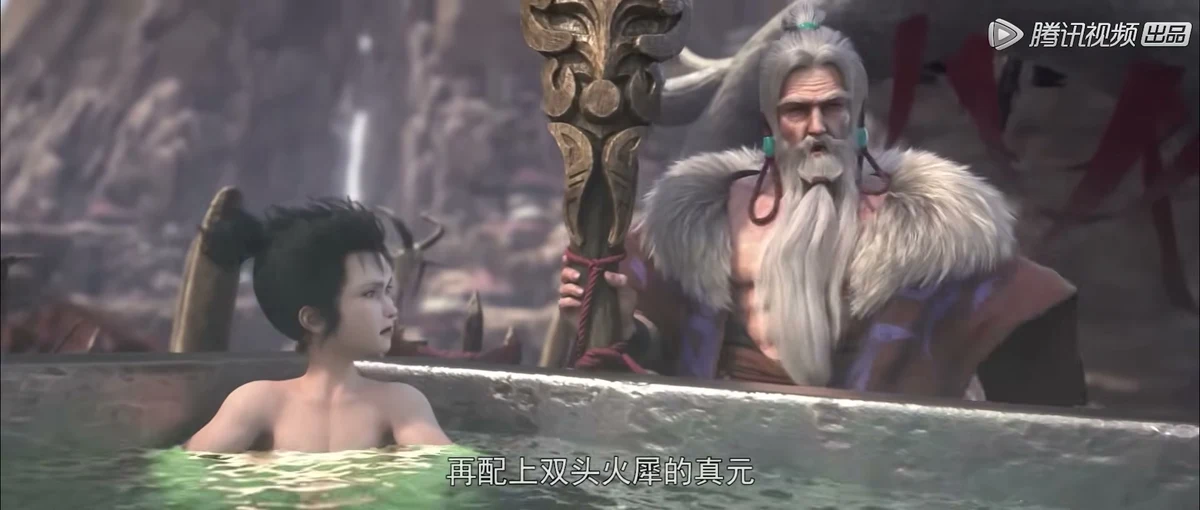
What the early stages actually mean
The village opening makes physical preparation easy to understand: Shi Hao’s body must endure the demands placed on it. Blood Transformation belongs to that foundation. Heavenly Passage is a further breakthrough, so an unusually strong child is not automatically at that later realm.
Heavenly Passage has its own internal progression: opening another passage develops that realm. The next major realm remains Spirit Transformation, regardless of how many passages a character opens first.
After Heavenly Passage, the terms shift toward spiritual refinement, inscriptions and formations. A spectacular attack alone will not identify the stage: the donghua gives even early battles considerable visual scale. Listen for the named breakthrough rather than judging the rank by the size of an explosion.
A concrete checkpoint comes in Chapter 396 of the licensed novel: Shi Hao reaches Formation Arrangement at fourteen, an achievement the narration treats as exceptional. The chapter identifies it as the fifth major realm. This is a novel chapter reference, not donghua episode 396.
Why Shi Hao can fight above his stated realm
A realm measures cultivation, not every advantage a fighter brings. Physical foundations, precious techniques, equipment, battlefield conditions and an opponent’s limitations all affect a confrontation. Shi Hao is an exceptional protagonist within the system; he is not a reliable example of what every cultivator at the same stage can accomplish.
Separate three kinds of statement when following him: the realm he has entered, how thoroughly he has developed that realm, and the strength he can display in a particular encounter. Only the first establishes his position in the main sequence. The other two help explain why a seemingly stronger opponent may still have a difficult fight.
For example, opening ten Heavenly Passages describes how far Shi Hao takes one realm. It does not move Heavenly Passage above Engravement in the standard sequence. His achievement and his realm answer different questions.
Why some lists include Holy Sacrifice and others skip it
Show the Holy Sacrifice explanation (later-realm spoilers)
Holy Sacrifice is associated with the transition between True Deity and Heavenly Deity, but it is not a compulsory, stable rung that every cultivator passes through in the same way. Its unusual nature explains why abbreviated charts sometimes leave it out.
The novel portrays unstable power during this phase. A moment that resembles Heavenly Deity strength does not by itself mean the character has securely reached Heavenly Deity. Chapter 992 illustrates that distinction; the passage contains later-story material.
If one list goes directly from True Deity to Heavenly Deity, it may be omitting this unusual phase rather than naming a different hierarchy. When the dialogue specifically says Holy Sacrifice, however, do not silently replace it with Heavenly Deity.
Higher realms in the novel: spoiler reference
Show the path beyond Venerable
The sequence continues after Venerable. Holy Sacrifice is included as a special transitional phase.
Scroll across to compare all columns →
| Realm or phase | Chinese name | Translation or reading note |
|---|---|---|
| Divine Flame | 神火 | Also called Divine Fire. |
| True Deity | 真一 | True One or True Self in other translations. |
| Holy Sacrifice | 圣祭 | Also Saint Sacrifice; a special transition rather than a universal requirement. |
| Heavenly Deity | 天神 | Also Heavenly God. Not Heavenly Passage. |
| Void Dao | 虚道 | Xu Dao. |
| Self-Severing | 斩我 | Also Severing the Self. |
| Self-Release | 遁一 | Dun Yi; sometimes translated as Escape One. |
| Supreme Being | 至尊 | Also Supreme. Distinct from the earlier Venerable/Supreme Expert. |
| True Immortal | 真仙 | The immortal path beyond the preceding mortal cultivation sequence. |
| Immortal King | 仙王 | Higher than True Immortal. |
| Quasi-Immortal Emperor | 准仙帝 | Also Half Immortal Emperor. |
| Immortal Emperor | 仙帝 | The completed emperor realm, not merely approaching it. |
Descriptions such as peak, giant or half-step can refine someone’s standing without creating another universally separate major realm. That is why two detailed lists may have different row counts even when they agree on the main sequence.
The distinction between Immortal King and the later half-emperor level is visible in Chapter 1985. This is a late-novel reference with substantial spoilers. Broader rankings that combine other Chen Dong novels answer a different question from this guide to Perfect World.
Heavenly Passage, Heavenly Deity and Void God Realm
Heavenly Passage is an early cultivation realm; Heavenly Deity is a much later one. Their similar English names do not indicate adjacent stages. Check 洞天 for the former and 天神 for the latter.
The Void God Realm is a setting, not the next personal rank after Heavenly Deity. Its regions and restrictions affect how characters can compete there. In the novel’s early Void God Realm material, access and permitted strength are part of how the space works. A character entering it has not automatically achieved a cultivation stage called Void God.
How to identify Shi Hao’s realm in your episode
Find the most recent named breakthrough in the episode you have reached, then match it to the table. If the subtitles say Inscription, look under Engravement (铭纹). If they say Divine Fire, open the later-realm chart and look for Divine Flame (神火).
The official Perfect World listing on WeTV provides a main-series episode sequence. Use that numbering when comparing discussions: a compilation may combine several episodes under one title.
For an assessment of the opening’s story and characters, see our Perfect World donghua review. The licensed English novel is available on Wuxiaworld.